fpga4fun.com - where FPGAs are fun.
Home
Welcome
Information


FPGA projects
Music box
Pong game
R/C servos
Text LCD module
Quadrature decoder
PWM and one-bit DAC
Debouncer
LED displays
Crossing clock domains
External contributions

FPGA interface projects
RS-232
JTAG
I2C
EPP
SPI
CNC steppers

FPGA advanced projects
Graphic LCD panel
Digital oscilloscope
10BASE-T interface
PCI interface
Spoc CPU core

Hands-on
A simple oscilloscope


FPGA introduction
What are FPGAs?
How FPGAs work
FPGA pins
Clocks and global lines
Download cables
Configuration
Learn more

FPGA software
Design software
Pin assignment
Design-entry/HDL
Simulation/HDL
Synthesis and P&R

FPGA electronic
SMD technology
Crystals and oscillators

HDL info
HDL tutorials
Verilog tips
VHDL tips

Quick-start guides
ISE
Quartus

Site
News
FPGA links
HDL tutorials
Forum


How FPGAs work

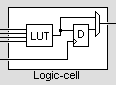
Logic-cell

FPGAs are built from one basic "logic-cell", duplicated hundreds or thousands of time. A logic-cell is basically a small lookup table ("LUT"), a D-flipflop and a 2-to-1 mux (to bypass the flipflop if desired).

The LUT is like a small RAM and has typically 4 inputs, so can implement any logic gate with up to 4-inputs. For example an AND gate with 3 inputs, whose result is then OR-ed with another input would fit in one LUT.

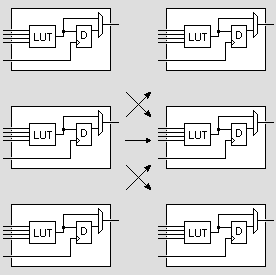
Interconnect

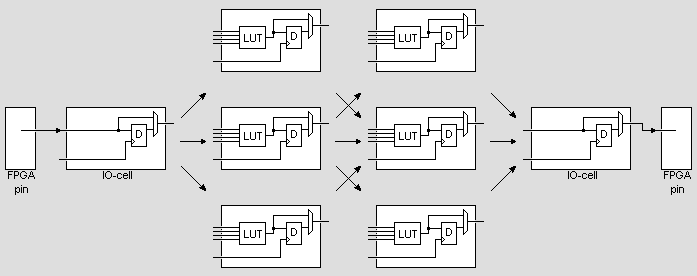
Each logic-cell can be connected to other logic-cells through interconnect resources (wires/muxes placed around the logic-cells). Each cell can do little, but with lots of them connected together, complex logic functions can be created.
The interconnect wires also go to the boundary of the device where I/O cells are implemented and connected to the pins of the FPGAs.

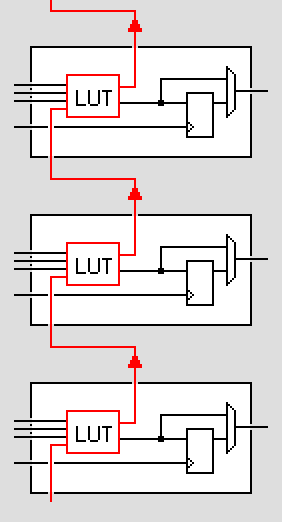
Dedicated routing/carry chains

In addition to general-purpose interconnect resources, FPGAs have fast dedicated lines in between neighboring logic cells. The most common type of fast dedicated lines are "carry chains". Carry chains allow creating arithmetic functions (like counters and adders) efficiently (low logic usage & high operating speed).

Older programmable technologies (PAL/CPLD) don't have carry chains and so are quickly limited when arithmetic operations are required.

Internal RAM

In addition to logic, all new FPGAs have dedicated blocks of static RAM distributed among and controlled by the logic elements.

Internal RAM operation

There are many parameters affecting RAM operation. The main parameter is the number of agents that can access the RAM simultaneously.

Here's a simplified drawing of a dual-port RAM.

To figure out how many agents are available, count the number of separate address buses going to the RAM. Each agent has a dedicated address bus. Each agent has also a read and a write data bus.

Writing to the RAM is usually done synchronously. Reading is usually done synchronously but can sometimes be done asynchronously.

Blockram vs. Distributed RAM

Now there are two types of internal RAMs in an FPGA: blockrams and distributed RAMs. The size of the RAM needed usually determines which type is used.

Distributed RAM brings a lot of flexibility in the RAM distribution in an FPGA, but isn't efficient in term of area (a logic-cell can actually hold very little RAM). Altera prefers building different size blockrams around the device (which is more area efficient, but less flexible). Which one is better for you depends on your FPGA application.


>>> NEXT: FPGA pins >>>


This page was last updated on February 05 2008.